


Tree · North Texas care guide
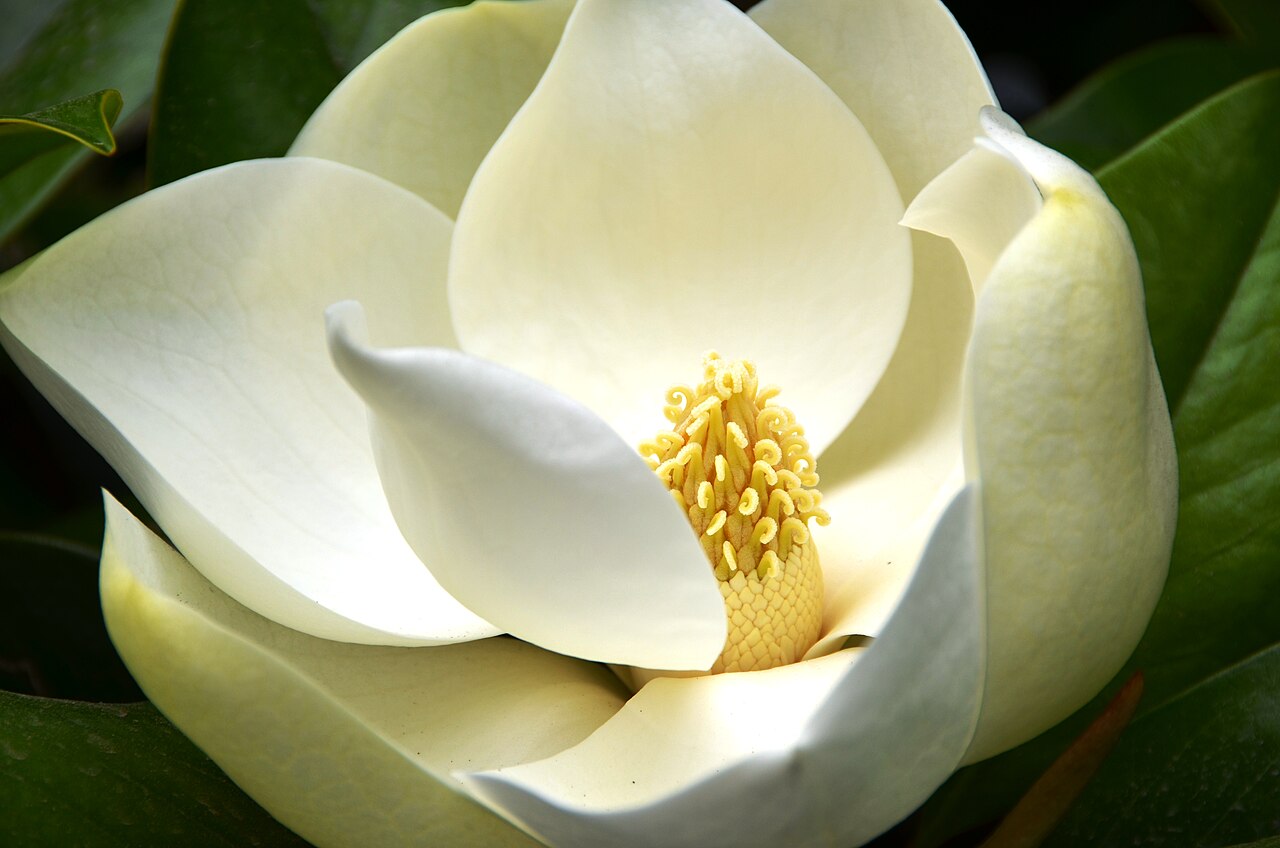
Magnolia grandiflora
Nursery Pro tip: The classic. 'D.D. Blanchard' and 'Claudia Wannamaker' hold their glossy leaves in our wind. Needs room and steady water the first two summers.
The classic — huge glossy evergreen leaves, dinner-plate white flowers with a lemon scent in May and June, and a grand pyramidal form reaching 40–60 ft. Slow to moderate, long-lived, and a statement in any front yard. 'D.D. Blanchard' (bronze leaf backs, dense) and 'Bracken's Brown Beauty' (hardier, smaller) are the best full-size selections here.
Full sun to part shade with room to spread 25–40 ft; keep it 12 ft off the house and away from the pool (it sheds leaves year-round). Prefers a bed enriched with compost over bare clay, and drainage.
Fall or spring. Wide hole, ball an inch high, native soil plus compost, Root Stimulator, a wide 3-inch mulch ring — shallow roots love it. Keep the lowest branches; a magnolia limbed to the ground is easier to live with than one dropping leaves on a lawn you have to mow.
Twice weekly the first summer, weekly the second and third; established trees want a deep soak every week or two in the heat.
Acid-loving or magnolia fertilizer in early spring and early summer; chelated iron and sulfur yearly in our pH to keep the leaves deep green.
Right after bloom, and only what's needed. Don't limb it up heavily all at once.
Iron chlorosis (treat early). Scale on leaf backs — dormant oil in winter. Leaf drop in late spring as new growth comes is normal, and constant in small amounts.
A lawn specimen. Underplant its skirt with nothing at all — it doesn't want competition — or holly fern and liriope at the edge.
Written for Rockwall's black clay, heat and winters by the Landscape Source team. Every yard is different — bring a photo by, or ask LS-Ai, and we'll tailor it to your spot.